Paediatric podotherapy
A child is not a small adult, and therefore deserves their own specialist in walking and movement.
Feet and legs in development
A child's body is growing rapidly and is constantly changing. At birth, all structures in the feet and legs are present in their basic form and will develop over the years into their adult shape, with the corresponding function.
Stages of development
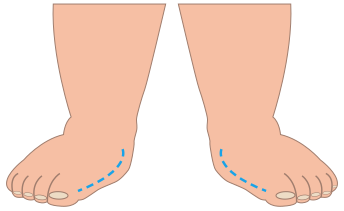
Flat baby feet
A baby's foot is flat because of a thick layer of fat under the sole. The feet consist mainly of cartilage, with little bone yet. Lots of kicking helps the muscles in the feet and legs develop.
Do the shape and position of the feet or legs not quite match what is usual for the age? That is usually no reason for concern: there is a wide variation in shapes. If in doubt, feel free to have it checked.
Read more about how children's feet develop+
During the development of the feet and legs, you see certain postures emerge that would be considered abnormal in an adult.
During puberty, the body undergoes a very significant change under the influence of hormones. This has a major impact on how much load the body can take, which can give rise to specific growth-related complaints in, for example, the heels or knees.
Which shoe suits your child?
Every stage of development calls for a different shoe, regardless of age or shoe size: every child develops at their own pace. See for each stage how firm the heel, midfoot and forefoot of the shoe should be.
What is your child doing now?
Heel
Slightly firm
Midfoot
Flexible
Forefoot
Flexible
- Cruising along furniture
- Holding hands
- With a push walker
- First independent steps
A slightly firmer heel counter gives a little extra support. The rest of the shoe stays flexible.
Children cannot yet feel properly whether a shoe is too small, because their nervous system is still developing. Check the size regularly.
Young feet consist mainly of soft cartilage. Socks or shoes that are too small, but also shoes that are too stiff, can hinder natural growth.
Toes make gripping movements for stability when standing and taking first steps. Give them room to do so in socks and shoes too.
Enjoying movement
Movement is very important for a child's overall development. But what if moving is difficult or painful?
Read more about movement and development+
For a child's motor development, but also for their social and emotional development, nothing is as important as enjoying movement and being able to join in with peers.
A child learns and develops through play. When there is pain, but also when a child tires quickly or trips regularly, the enjoyment of movement decreases.
Is moving freely or playing sport difficult, or is there pain? Do not wait too long to seek help. A child's body is fundamentally different from an adult's.
Our approach
What would be an abnormality in an adult can be a normal part of development in a child. That is precisely why specialist knowledge of children's feet and legs, and how they develop, is essential.
As a parent, you can watch for the following signals: your child trips noticeably often, complains of tired or painful legs, walks with the feet turned inwards or outwards, has growing pains that do not go away, does not want to walk or play sport, or has a striking gait pattern. Uneven wear on shoes can also be a reason for a podotherapeutic examination.
Our paediatric podotherapist Lilianne van Houten specialises in the diagnosis and treatment of foot complaints in children. With a child-friendly approach, she examines the foot position, the gait pattern and overall motor development. Treatment may consist of light podotherapeutic insoles that support natural development, possibly supplemented with exercises and footwear advice.
Results in children are often remarkably fast: 85% of the children we treat are pain-free within a few weeks and walk noticeably better.
Are you concerned about your child's feet, or is there a striking gait pattern? Book an appointment for a child-friendly examination.
Children can come to us for
Tiring quickly when walking (not wanting to walk or not managing long distances)
Falling or tripping frequently
Walking with the feet turned inwards or outwards
Pain in the feet, legs or back
Growing pains in feet and legs (particularly when recurrent)
Rapid or uneven wear on shoes
An abnormal posture
Where necessary, we coordinate with other disciplines such as your GP, a (paediatric) physiotherapist, a manual therapist or an orthopaedic shoemaker, so that your child receives the right care at the right time.
Book an appointmentReady to address your complaints?
Call us or make an appointment online. We are available on weekdays from 8:30 to 17:00.