Our treatments
Every treatment at Podotherapie Rotterdam begins with a thorough examination of the entire movement chain. We look not only at the position of the feet, ankles, knees, hips and back, but also assess functional properties such as joint mobility, muscle strength and the condition of the connective tissue.
Gait analysis is another important part of assessing your complaint. Once we understand the cause of your complaints, we draw up a treatment plan. Below you will find an overview of all our treatment options.
Podomanual therapy
Manual podotherapy is a hands-on treatment technique aimed at mobilising stiff joints in the foot, ankle and knee. The foot contains 26 bones and dozens of joints, all of which need a specific range of movement for healthy gait function. If one or more joints are restricted in their movement, the way the foot rolls through changes and compensatory movements arise that can lead to complaints in the foot or lower leg, but also in the knee, hip or back.
In podomanual therapy, the podotherapist applies targeted, short manipulations to the joint concerned to restore normal mobility. This is supplemented with mobilisation techniques and stretching exercises. The treatment is generally not painful; you may feel some pressure or hear or feel a click, comparable to cracking your fingers.
Podomanual therapy is often combined with fascia therapy and can be supplemented with podotherapeutic insoles. In that case the insoles are guiding, in order to maintain the mobility of the treated joints. This way you treat the cause and create good conditions for proper recovery.
This combination often gives good results in patients with, for example, heel complaints, Achilles tendon complaints, a Morton's neuroma or restricted ankle mobility after an injury, but also with knee or hip complaints. Examination and treatment are often reimbursed from supplementary health insurance.
Do you have stiff feet or restricted ankle mobility? Book an appointment for podomanual treatment.
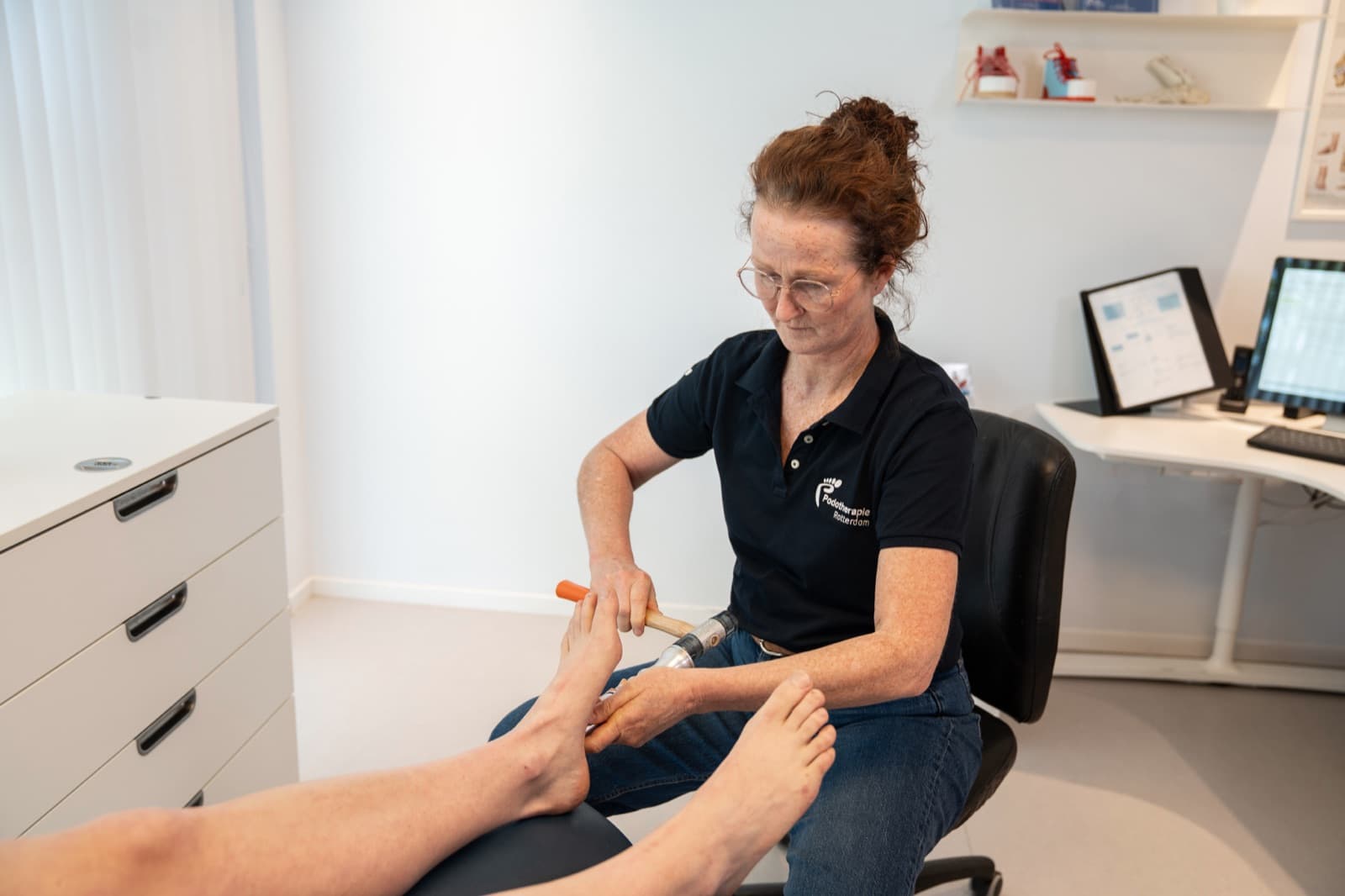
Fascia therapy
Fascia, also known as connective tissue, is a network of connective tissue structures that envelops and connects muscles, tendons, bones and organs. Healthy fascia is supple and allows muscles and tendons to glide freely past one another. Through overload, inactivity, injury or chronic tension, fascia can become adherent and thickened. This restricts mobility and causes pain.
Fascia therapy at Podotherapie Rotterdam focuses mainly on the connective tissue in the lower extremity: foot, lower leg, upper leg and pelvis. In heel spur and plantar fascia complaints, the plantar fascia is often thickened and adherent. Using specific pressure techniques and tools that support these techniques, supplemented with exercises you can do at home, we help restore the suppleness of the tissue.
The effect of fascia therapy is cumulative: after each treatment, tissue circulation improves and stiffness decreases. Most patients notice a clear improvement after two to four treatments. We often combine fascia therapy with podomanual therapy and medical taping. Podotherapeutic insoles can also be a valuable addition in achieving an optimal treatment result. Examination and treatment are often reimbursed from supplementary health insurance.
Suffering from a stiff sole or chronic heel spur complaints? Get in touch and ask about fascia therapy.
Podotherapeutic insoles (custom orthotics)
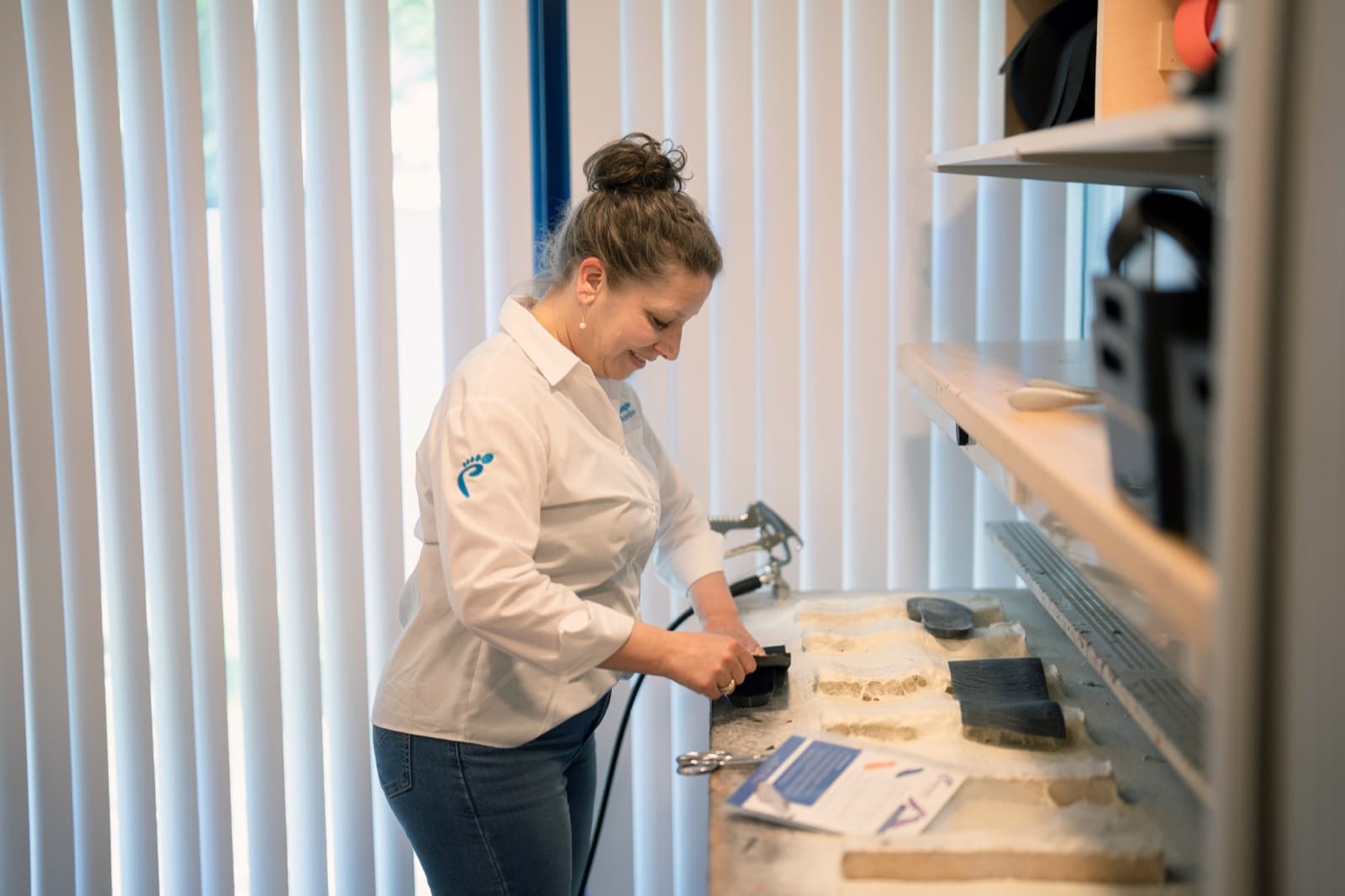
When we fit podotherapeutic insoles, the foot is scanned in 3D to record its exact shape. Based on the data from the examination, the gait analysis and the 3D scan, an insole plan is drawn up. This plan may have a corrective, supportive, guiding and/or offloading purpose. Depending on the goal, we can use different materials and degrees of hardness. We manufacture the insoles ourselves using 3D printers. Unlike off-the-shelf insoles bought in a shop or online, podotherapeutic insoles are made entirely to measure.
After the insoles have been delivered, a follow-up appointment takes place to evaluate whether they are helping. During this visit, your gait pattern on the insoles and in your shoes is assessed. We have our own workshop where the insoles can be adjusted immediately if necessary.
Podotherapeutic insoles are used for a wide range of complaints: fallen arches, heel spur, plantar fasciitis, knee complaints, hip complaints, back pain, leg length difference, hallux valgus and sports-related injuries. They can also provide support for children with motor development delays.
Podotherapeutic insoles are often reimbursed from supplementary health insurance.
Would you like to find out whether podotherapeutic insoles could help you? Book an appointment for a no-obligation examination.
Silicone orthoses (toe props)
Silicone orthoses are custom-made silicone pieces produced directly on the foot, usually on the toes. They are used for toe position abnormalities such as hallux valgus (a crooked big toe), hammer toes, claw toes and overlapping toes. They also provide effective relief for callus, corns and pressure points between the toes.
With hallux valgus, the big toe deviates towards the other toes, creating a painful bump on the inside of the foot. A silicone orthosis reduces the pressure on that bump. With hammer toes and claw toes, the orthoses protect the top of the toes against friction inside the shoe and prevent the formation of callus and corns.
The advantage of silicone orthoses is that they are modelled precisely to your foot. The podotherapist applies silicone in paste form around the toe and shapes it while it hardens. This creates a perfect fit that is comfortable to wear in your shoe. The orthoses are washable, durable and last one to two years on average.
Bothered by a crooked big toe or painful hammer toes? Get in touch for an assessment and treatment with silicone orthoses.
(Medical) taping
Medical taping is a treatment technique in which elastic tape is applied to the skin in a specific way to support muscles, joints and tendons. The tape is water resistant and stays in place for three to five days on average. At Podotherapie Rotterdam, medical taping is used as a temporary solution to relieve acute complaints, but also as a supplement to other treatments.
The applications are broad: with heel spur and plantar fasciitis the tape offloads the plantar fascia, with a sprained ankle the tape stabilises the joint, with shin splints the tape reduces traction on the shin membrane, and with Achilles tendon complaints the tape supports the tendon during movement. Taping can also be used with hallux valgus to temporarily correct the position of the toe.
The difference with more structural treatments such as insoles is that medical taping offers a temporary solution. The tape works as long as it is on the skin and must be replaced regularly. We often use taping in the acute phase of a complaint, as a diagnostic aid to test which correction works best, or as a bridge while insoles are being made.
Do you have pain or other complaints? Book an appointment.
Felt techniques
Felt techniques are a fast and effective way to support or offload the foot temporarily. The podotherapist applies specially shaped felt directly to the foot or inside the shoe to reduce pressure points, support the arch of the foot or offload painful areas. Felt provides immediate relief for acute complaints.
We often use felt techniques as a diagnostic aid. Before we manufacture insoles, we test with felt which correction has the best effect. By wearing the felt for a few days and evaluating the response, we can fine-tune the insoles more accurately. Felt techniques also offer an immediate solution for patients who need relief quickly, for example with acute metatarsalgia or with pressure points or blisters under the foot.
The felt is self-adhesive and stays on the foot for two to five days on average. It is not suitable as a permanent solution, but bridges the period until the insoles are ready, or provides a short-term treatment for temporary complaints.
Do you have acute pressure complaints? Book an appointment. We can offer relief immediately using felt techniques.
Specialisms
Sports podotherapy
Prevention and treatment of sports injuries for every athlete, from amateur to professional.
Read more about sports podotherapy →Paediatric podotherapy
Specialist care for feet and legs that are still developing.
Read more about paediatric podotherapy →Frequently asked questions about our treatments
How long do podotherapeutic insoles last?+
Podotherapeutic insoles last two to three years on average, depending on use and materials. With intensive sports use, the lifespan may be shorter. We check annually whether the insoles still provide sufficient support and replace them when necessary. Replacement is reimbursed by your health insurer in most cases.
What is the difference between insoles from a podotherapist and shop-bought insoles?+
Off-the-shelf insoles from a shop or online offer general support and are not suitable for every foot type. The support is mainly located in the arch or just behind the ball of the foot. With a higher arched foot type, or a foot that sits more on its outer edge, an off-the-shelf insole can cause overcorrection. Podotherapeutic insoles are made entirely to measure on the basis of a thorough examination, a gait analysis and a 3D scan of your foot. They are made for your specific foot position and gait pattern and are tailored to your complaints, build and activity level. Only physically fitted podotherapeutic insoles can be reimbursed by health insurance.
Is the treatment painful?+
Most treatments are not painful. With manual podotherapy you may feel pressure on stiff joints, but this is generally well tolerated. Fascia therapy can create some pressure in sensitive areas, but is always adjusted to your pain threshold. Wearing new insoles may take some getting used to during the first few days, but should never be painful.
Do I need a referral from my GP?+
No, you do not need a referral to visit us. Podotherapy is directly accessible. You can make an appointment yourself via our website or by phone. Treatments are largely reimbursed from the supplementary cover of your health insurance, even without a referral.
Can I wear my insoles in several pairs of shoes?+
Insoles are made for a specific type of shoe and can in most cases be swapped between shoes of the same type. If you need insoles for different shoe types, for example work and sports shoes, we can fit a second pair. We always advise bringing the shoes you wear most often to your appointment.
Ready to address your complaints?
Call us or make an appointment online. We are available on weekdays from 8:30 to 17:00.